
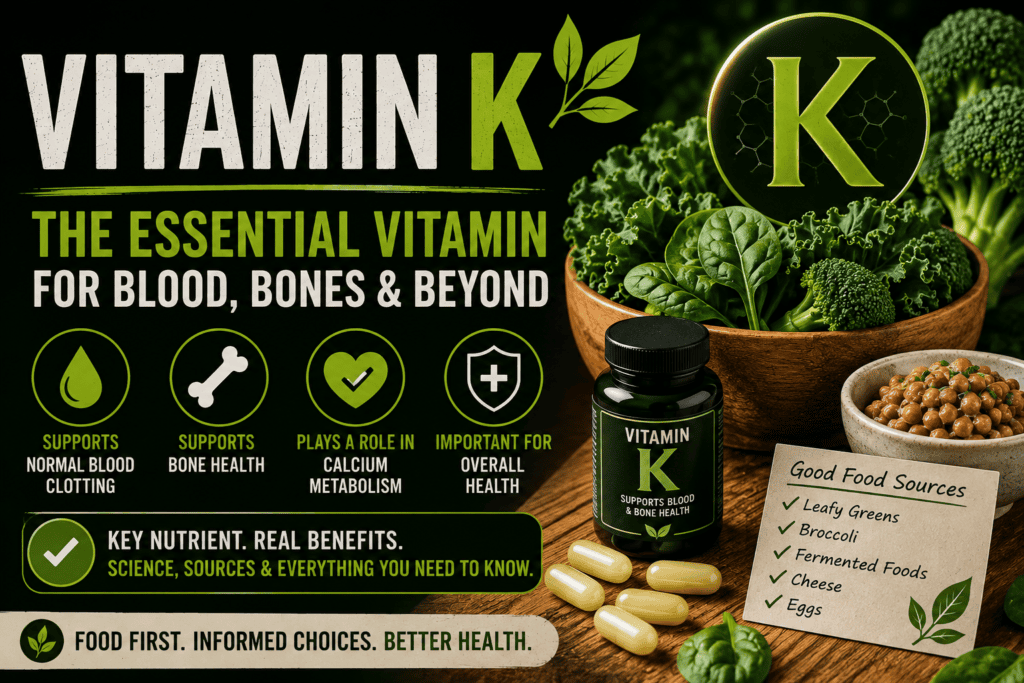
Vitamin K Explained: Blood Clotting, Bones, K1 vs K2 and What the Science Really Says
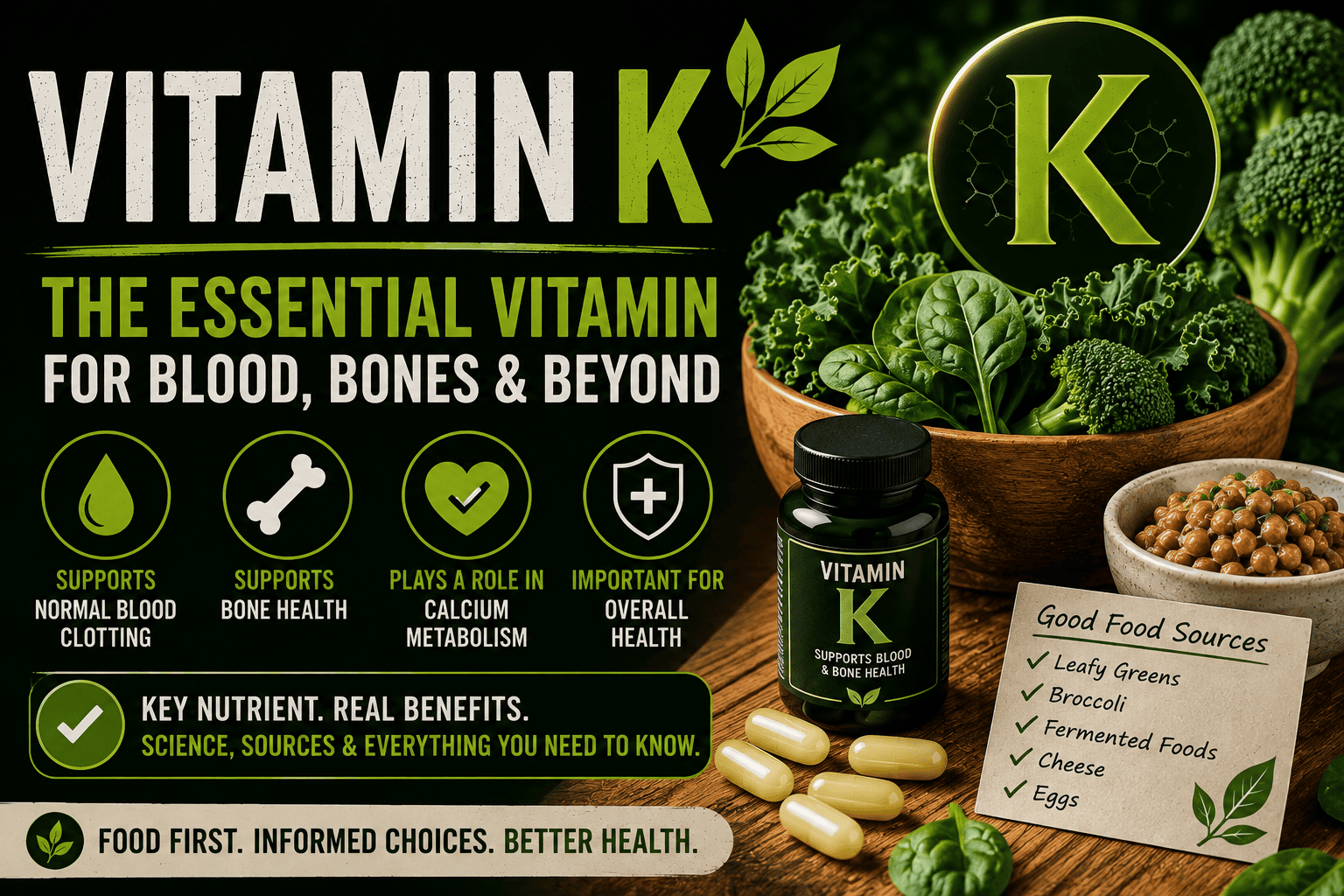
Vitamin K has a slightly unfortunate reputation.
Vitamin C gets immunity. Vitamin D gets sunshine. B vitamins get energy. Vitamin A gets vision.
Vitamin K gets blood clotting.
Useful, certainly.
Not exactly glamorous.
Yet vitamin K is considerably more interesting than its reputation suggests. It is an essential fat-soluble vitamin involved in activating proteins required for normal blood coagulation, and it also participates in the biology of bone and other tissues.
More recently, vitamin K2 supplements have become increasingly popular, particularly alongside vitamin D, with claims ranging from stronger bones to cleaner arteries, improved heart health and even better brain function.
Some of those claims have plausible biological foundations.
Plausible, however, is not the same as proven.
So what does vitamin K actually do? Is K2 better than K1? Should everyone taking vitamin D also take vitamin K2? And what happens if you’re taking warfarin?
Let’s look at the evidence.
What Is Vitamin K?
Vitamin K is a family of fat-soluble compounds rather than one single molecule.
The two major groups discussed in human nutrition are:
- Vitamin K1, or phylloquinone
- Vitamin K2, or menaquinones
Vitamin K1 is predominantly found in plant foods, particularly green leafy vegetables.
Vitamin K2 refers to a family of menaquinones, commonly abbreviated according to the length of their side chain, such as MK-4 and MK-7.
Different menaquinones occur in certain animal and fermented foods and can also be produced by bacteria.
They are related compounds, but their absorption, metabolism and biological half-lives are not identical.
What Does Vitamin K Actually Do?
Vitamin K acts as a cofactor for an enzyme involved in a process called gamma-carboxylation.
That sounds like the sort of phrase designed specifically to make people stop reading nutrition articles.
The practical explanation is much easier.
Several proteins in the body need to be chemically modified before they can function properly. Vitamin K helps make that modification possible.
These vitamin K-dependent proteins include several involved in:
- Blood coagulation
- Regulation of coagulation
- Bone metabolism
- Other processes involving calcium handling within tissues
Without sufficient vitamin K, some of these proteins cannot function normally.
Vitamin K and Blood Clotting
This is vitamin K’s best-established role.
Several coagulation factors depend on vitamin K for their normal biological activity, including factors II, VII, IX and X.
Vitamin K is also required for proteins C and S, which help regulate coagulation.
So describing vitamin K simply as the “blood clotting vitamin” is understandable, but slightly incomplete.
It contributes to a carefully regulated coagulation system rather than simply telling your blood to clot as much as possible.
Biology generally prefers balance.
What Happens If You Don’t Get Enough Vitamin K?
Clinically significant vitamin K deficiency can impair normal blood coagulation and increase bleeding risk.
Possible signs of significant deficiency can include:
- Easy bruising
- Bleeding
- Prolonged clotting
- Blood in the stool or urine in severe cases
Fortunately, overt vitamin K deficiency is uncommon in healthy adults eating a varied diet.
Deficiency becomes more likely in situations involving significant fat malabsorption, certain gastrointestinal disorders or medications that interfere with vitamin K metabolism.
Why Do Newborn Babies Receive Vitamin K?
This is one of vitamin K’s most important medical uses.
Babies are born with relatively low vitamin K stores. Transfer of vitamin K across the placenta is limited, the newborn gut does not initially provide a substantial bacterial contribution, and breast milk contains relatively small amounts.
This creates a risk of vitamin K deficiency bleeding, sometimes abbreviated to VKDB.
VKDB can be extremely serious because bleeding can occur internally, including within the brain.
Vitamin K prophylaxis shortly after birth dramatically reduces this risk.
This is not a trendy wellness intervention.
It is preventive medicine with a very clear purpose.
Vitamin K and Bone Health
This is where vitamin K starts appearing more frequently in the supplement aisle.
One vitamin K-dependent protein is osteocalcin, a protein produced by bone-forming cells.
Vitamin K is required for the carboxylation of osteocalcin, which helps enable its normal biological function.
That provides a genuine mechanistic reason to investigate vitamin K and bone health.
Researchers have therefore studied whether vitamin K supplementation can improve bone mineral density or reduce fractures.
The answer is not as straightforward as supplement advertising sometimes suggests.
Does Vitamin K2 Strengthen Bones?
Some studies have reported potentially favourable effects of vitamin K, particularly certain K2 preparations, on markers of bone metabolism and some measures of bone health.
However, results across trials and reviews have been inconsistent, with differences in population, dose, form of vitamin K and study quality.
This means there is biological plausibility and some encouraging evidence, but it does not justify treating routine K2 supplementation as an established requirement for every healthy adult.
Bone health is also considerably bigger than one vitamin.
Important factors include:
- Adequate calcium intake
- Adequate vitamin D status
- Protein intake
- Resistance and weight-bearing exercise
- Hormonal health
- Smoking and alcohol exposure
- Age and genetics
No single softgel gets to take credit for the entire skeleton.
Vitamin K2 and Heart Health
This is probably the most heavily marketed modern use of vitamin K2.
Another vitamin K-dependent protein, matrix Gla protein, is involved in regulating calcification within blood vessels and other soft tissues.
This has led to a popular theory that vitamin K2 helps “direct calcium into the bones and away from the arteries”.
That phrase is catchy.
It is also a substantial simplification of some very complicated physiology.
Observational studies and clinical trials have investigated vitamin K status and vascular calcification, but evidence that routine K2 supplementation prevents cardiovascular disease or reliably reverses arterial calcification remains insufficient.
The mechanism is interesting.
The clinical promise is interesting.
Routine cardiovascular treatment? Not established.
Should You Take Vitamin K2 With Vitamin D?
This combination appears everywhere online.
The logic usually goes something like this: vitamin D increases calcium absorption, while vitamin K activates proteins involved in calcium metabolism, therefore everyone taking vitamin D must also take K2.
There is some biological logic behind studying the nutrients together.
But the final conclusion is too strong.
There is not currently convincing evidence that every person taking a normal vitamin D supplement also needs a separate K2 supplement.
That does not mean K2 is useless.
It means “vitamin D must always be taken with K2” is a stronger claim than current evidence supports.
K1 vs K2: What’s the Difference?
Vitamin K1 and K2 both contribute to vitamin K-dependent biological processes, but they differ in their chemical structures, dietary sources and pharmacokinetics.
Vitamin K1 is the predominant dietary form in many diets and is particularly abundant in green vegetables.
Vitamin K2 consists of several menaquinones.
Two forms frequently seen in supplements are:
- MK-4
- MK-7
MK-7 has a relatively long circulating half-life compared with vitamin K1 and MK-4, which allows blood concentrations to remain elevated for longer after supplementation.
This pharmacological difference does not automatically mean MK-7 is universally “better”.
Longer lasting and clinically superior are not synonyms.
What Foods Contain Vitamin K1?
Green vegetables are the stars here.
Good sources include:
- Kale
- Spinach
- Broccoli
- Brussels sprouts
- Cabbage
- Other green leafy vegetables
- Some vegetable oils
A portion of leafy greens can contain a substantial amount of vitamin K1.
Your salad has apparently been doing coagulation biochemistry this entire time without mentioning it.
Where Does Vitamin K2 Come From?
Menaquinones are found in certain fermented foods and some animal-derived foods.
The most famous dietary source is natto, a traditional Japanese fermented soybean food that is particularly rich in MK-7.
Some cheeses and other fermented foods can also provide menaquinones, although the amount and specific forms vary considerably.
Small amounts of particular K2 forms are also present in foods such as eggs and meat.
Does Gut Bacteria Make Vitamin K?
Yes, certain bacteria in the gastrointestinal tract can produce menaquinones.
However, exactly how much this contributes to human vitamin K requirements remains uncertain because much of the bacterial production occurs in the colon, while absorption and bioavailability vary.
So “your gut bacteria make vitamin K” is true.
“Therefore dietary vitamin K doesn’t matter” is not.
How Much Vitamin K Do You Need?
Recommendations differ depending on the country and the system used to establish nutritional requirements.
In the United States, adequate intake levels for adults are approximately:
- 120 mcg per day for adult men
- 90 mcg per day for adult women
UK guidance takes a different approach.
The NHS states that adults need approximately 1 microgram of vitamin K per kilogram of body weight per day.
So, for example, a person weighing 70 kg would need approximately 70 mcg per day according to that general UK estimate.
Most people should be able to obtain sufficient vitamin K from a varied diet.
Can You Take Too Much Vitamin K?
Unlike some other fat-soluble vitamins, vitamin K1 and K2 have relatively low documented toxicity from ordinary dietary and supplemental intake in healthy adults.
No conventional tolerable upper intake level has been established for naturally occurring vitamin K forms because evidence of toxicity is limited.
That should not be interpreted as permission to take unlimited amounts.
More importantly, vitamin K has one clinically significant interaction that completely changes the conversation for some people.
Vitamin K and Warfarin
If there is one section of this article worth remembering, it is this one.
Warfarin works by interfering with the vitamin K cycle, thereby reducing the activation of several vitamin K-dependent clotting factors.
This means significant changes in vitamin K intake can alter the anticoagulant effect of warfarin.
And this leads to one of the biggest misconceptions surrounding vitamin K.
People taking warfarin are not generally told to eliminate vitamin K from their diet.
The key issue is consistency.
Why Consistency Matters More Than Avoidance
Imagine someone taking warfarin who normally eats very few green vegetables.
They suddenly decide to become exceptionally healthy and begin consuming enormous spinach smoothies, kale salads and broccoli every day.
That major increase in vitamin K intake could alter their response to warfarin.
The reverse can also happen.
Someone who regularly consumes vitamin K-rich foods and then abruptly removes them may also change the stability of their anticoagulation.
The objective is therefore usually to maintain a reasonably consistent pattern of vitamin K intake while warfarin dosing and INR monitoring are managed accordingly.
Do not dramatically change your intake or start a vitamin K supplement without discussing it with the healthcare team managing your anticoagulation.
What About Other Blood Thinners?
Not every anticoagulant works like warfarin.
Direct oral anticoagulants such as apixaban, rivaroxaban, edoxaban and dabigatran do not rely on vitamin K antagonism in the same way.
Therefore, the classic vitamin K dietary interaction associated with warfarin does not generally apply to these medicines in the same way.
However, anyone taking anticoagulant or antiplatelet medication should still discuss new supplements with a pharmacist or prescriber rather than assuming every product is harmless.
Does Vitamin K Improve Brain Function?
Vitamin K-dependent proteins and vitamin K compounds are present within nervous tissue, and researchers have investigated potential relationships between vitamin K status and cognition.
Observational research has produced some interesting associations.
However, evidence is not currently sufficient to establish vitamin K supplementation as a reliable cognitive enhancer in healthy adults.
So, once again:
Important for normal biology does not automatically mean nootropic.
Does Vitamin K Improve Exercise Performance?
There is no established evidence that routine vitamin K supplementation improves strength, endurance, muscle growth or athletic performance in vitamin K-replete adults.
Vitamin K certainly contributes to normal physiology.
But if your pre-workout currently lacks MK-7, there is no compelling reason to panic.
Does Vitamin K Help With Energy?
Vitamin K is not an energy supplement in the conventional sense.
There is no reliable evidence that taking extra vitamin K provides a noticeable energy boost in healthy people with adequate nutritional status.
If fatigue is persistent, unexplained or significant, investigating common causes is considerably more sensible than cycling through random vitamin bottles.
Should Everyone Take Vitamin K2?
No convincing evidence currently supports routine K2 supplementation for every healthy adult.
There are interesting research areas involving bone health, vascular calcification and vitamin K-dependent proteins, and future research may clarify which groups benefit most.
For now, however, “everyone needs K2” goes beyond what we actually know.
If your diet contains plenty of vegetables and other nutritious foods, you may already be obtaining adequate vitamin K without ever owning a bottle labelled MK-7.
Vitamin K1 vs K2: Quick Comparison
| Feature | Vitamin K1 | Vitamin K2 |
|---|---|---|
| Other name | Phylloquinone | Menaquinones |
| Major sources | Leafy green vegetables | Fermented foods and some animal foods |
| Role in coagulation | Yes | Yes |
| Bone-health interest | Yes | Yes, particularly MK-4/MK-7 research |
| Common supplement forms | K1 | MK-4 and MK-7 |
| Proven cognitive enhancer | No | No |
| Proven performance enhancer | No | No |
What Forms Do Vitamin K Supplements Come In?
Vitamin K supplements are commonly available as:
- Tablets
- Capsules
- Softgels
- Combination vitamin D and K products
- Multivitamin and mineral supplements
K2 supplements commonly contain MK-7 or MK-4.
Because vitamin K is fat soluble, absorption occurs alongside dietary fat, although you do not need to construct an elaborate high-fat meal purely for your supplement.
Food First Still Makes Sense
For most healthy adults, vitamin K is another nutrient where an ordinary varied diet can do a remarkably good job.
Leafy greens provide vitamin K1 alongside fibre, folate, carotenoids and numerous other nutrients.
Broccoli and Brussels sprouts contribute vitamin K alongside an entire collection of other useful compounds.
Fermented foods can provide certain K2 forms while contributing other nutrients depending on the food.
Supplements isolate one component.
Food brings friends.
The Bottom Line
Vitamin K is essential.
Its role in normal blood coagulation is firmly established, and vitamin K-dependent proteins also participate in bone metabolism and other aspects of human physiology.
Vitamin K1 comes primarily from plant foods, especially leafy green vegetables, while vitamin K2 includes several menaquinones found in fermented and some animal foods.
Research into K2 and bone or cardiovascular health is genuinely interesting.
But interesting evidence is not the same as proof that every healthy adult needs a K2 supplement.
There is also no established evidence that routine vitamin K supplementation improves cognition, energy or athletic performance in people who already have adequate vitamin K status.
For most people, eating plenty of vegetables will provide a meaningful supply of vitamin K without much thought.
There is one major exception to the casual approach.
Warfarin.
If you take warfarin or another vitamin K antagonist, do not suddenly eliminate leafy greens and do not suddenly start consuming huge quantities either. Keeping vitamin K intake reasonably consistent is usually far more important than trying to make your diet completely vitamin K-free.
And never start a vitamin K supplement without checking with the healthcare team managing your anticoagulation.
Vitamin K may not have the celebrity status of vitamin D or vitamin C.
It doesn’t need it.
It already has an essential job.
Important: This article is for general educational purposes and is not a substitute for individual medical advice. If you take warfarin or another anticoagulant, have a bleeding disorder, have a condition affecting fat absorption, or are considering high-dose vitamin K supplementation, speak to a pharmacist, doctor, dietitian or other appropriately qualified healthcare professional before making significant changes to your diet or supplements.