
# Folate (Vitamin B9) Explained: Pregnancy, Deficiency, Folic Acid, Methylfolate and What the Science Says
Some supplements become famous because of gym performance, energy claims or promises of better brain function.
Folate became important for a much more fundamental reason.
Building humans.
Vitamin B9 is essential for DNA synthesis, cell division and the production of healthy blood cells. During periods of extremely rapid growth, particularly the earliest stages of pregnancy, having enough folate becomes especially important.
In fact, folic acid supplementation before conception and during early pregnancy is one of the clearest examples of a vitamin supplement having a genuinely important, evidence-based role in public health.
But folate has also been pulled into the wider supplement world.
Search online and you will find methylfolate promoted for energy, mood, cognition, detoxification, methylation and everything in between. Some claims have legitimate biochemical ideas sitting behind them. Others take an essential nutrient and give it abilities that clinical research hasn’t actually established.
So what does vitamin B9 really do, who needs supplements, and is methylfolate actually better than ordinary folic acid?
Let’s separate the biochemistry from the marketing.
What Is Folate?
Folate is the general term used for naturally occurring forms of vitamin B9 found in food.
Folic acid is the synthetic form commonly used in supplements and fortified foods.
You may also encounter 5-MTHF, sometimes called L-methylfolate or methylfolate, in supplements.
Although these forms are related, they are not chemically identical. The body ultimately converts folate compounds into biologically active forms that can participate in essential metabolic processes.
And there are quite a few of those.
What Does Vitamin B9 Actually Do?
Folate is involved in one-carbon metabolism, a collection of biochemical reactions essential for processes including DNA synthesis and methylation.
In practical terms, folate contributes to:
- Normal DNA synthesis
- Cell division
- Formation of healthy red blood cells
- Amino-acid metabolism
- Homocysteine metabolism
- Normal development during pregnancy
Cells that divide rapidly are particularly dependent on an adequate folate supply.
This is one reason deficiency can affect blood-cell production, and why folate becomes so important during the extraordinarily rapid cellular development occurring in early pregnancy.
Why Is Folic Acid So Important Before Pregnancy?
This is where the evidence becomes particularly strong.
Adequate folate around conception and during early pregnancy substantially reduces the risk of neural tube defects, serious developmental abnormalities affecting the brain and spinal cord.
These include conditions such as spina bifida and anencephaly.
The neural tube develops and closes extremely early in pregnancy, usually before many people even realise they are pregnant.
That timing is crucial.
If you wait for a positive pregnancy test before thinking about folic acid, some of the most important developmental events have already started.
How Much Folic Acid Is Recommended Before and During Pregnancy?
Recommendations differ somewhat between countries, which is why you may see figures ranging from around 400 to 800 micrograms (mcg) per day in pregnancy-related supplements and guidance.
In the UK, the standard NHS recommendation is particularly straightforward:
Take 400 mcg of folic acid every day before becoming pregnant and continue until 12 weeks of pregnancy.
Ideally, supplementation should begin while trying to conceive rather than waiting until pregnancy has been confirmed.
This is supplementation with a very specific purpose, at a very specific time, supported by strong evidence.
Do Some People Need More Folic Acid?
Yes.
Some people have a higher risk of having a pregnancy affected by a neural tube defect and may be advised to take a substantially higher dose of folic acid.
In the UK, higher-dose folic acid may be recommended in circumstances including certain previous pregnancies affected by neural tube defects, particular medical conditions, family history or use of certain medicines.
Higher-dose folic acid should be taken according to healthcare advice rather than simply deciding that if 400 mcg is useful, several thousand micrograms must be even better.
Vitamin dosing doesn’t work like a high score competition.
What Happens If You Become Folate Deficient?
Severe or prolonged folate deficiency can interfere with normal DNA synthesis and red blood cell formation.
One potential consequence is megaloblastic anaemia, in which abnormal, enlarged red-cell precursors develop because DNA synthesis has been impaired.
Symptoms associated with folate-deficiency anaemia can include:
- Fatigue
- Weakness
- Reduced exercise tolerance
- Shortness of breath
- Palpitations
- Sore or inflamed tongue
Of course, those symptoms are not specific to folate deficiency.
Feeling tired does not automatically mean you need a B9 supplement, regardless of what an online symptom checker may have convinced you at 11:30 at night.
What Causes Folate Deficiency?
Folate deficiency can occur for several reasons.
- Low dietary intake
- Malabsorption conditions
- Increased requirements, including pregnancy
- Excessive alcohol consumption
- Certain medicines that interfere with folate metabolism
- Some chronic medical conditions
Finding the cause matters because blindly replacing folate does not necessarily address the underlying problem.
The Important Link Between Folate and Vitamin B12
This is one of the most important safety considerations surrounding high folic acid intake.
Folate deficiency and vitamin B12 deficiency can both produce megaloblastic anaemia.
Giving enough folic acid can improve the blood abnormalities caused by vitamin B12 deficiency without correcting the underlying B12 deficiency itself.
That creates a potentially serious problem.
Vitamin B12 deficiency can cause neurological damage. If folic acid improves the anaemia, an important warning sign of B12 deficiency can become less obvious while neurological complications continue to develop.
This is what people mean when they say excessive folic acid can “mask” vitamin B12 deficiency.
It is also why unexplained anaemia should be properly investigated rather than self-treated with increasingly elaborate combinations of B vitamins.
Folic Acid vs Methylfolate: What’s the Difference?
This has become one of the more confusing corners of the supplement industry.
Folic acid is a stable synthetic form of vitamin B9 used extensively in supplements and food fortification.
Methylfolate, commonly provided as 5-MTHF, is a biologically active form of folate that can participate directly in folate metabolism.
Supplement marketing sometimes presents this as though folic acid is an outdated inferior product that virtually nobody can use properly.
That is not supported by the evidence.
Folic acid has an enormous evidence base, particularly for the prevention of neural tube defects, and remains the form specifically recommended in UK public-health guidance for people who are pregnant or trying to conceive.
What About MTHFR?
You cannot spend very long researching methylfolate online without encountering MTHFR.
MTHFR is an enzyme involved in folate metabolism. Common genetic variants can reduce its activity to varying degrees.
This fact has generated an enormous industry of genetic testing, supplements and online claims.
However, having a common MTHFR variant does not mean your body is incapable of using folic acid. Public-health authorities including the US Centers for Disease Control and Prevention continue to emphasise that people with common MTHFR variants can process folic acid, and folic acid remains the form with established evidence for neural tube defect prevention.
Genetics are important.
They are also considerably more complicated than a social-media graphic declaring that you “can’t methylate folic acid”.
Is Methylfolate Useless Then?
No.
Methylfolate is a legitimate form of folate and is used in supplements and particular clinical circumstances.
The problem arises when its existence is used to suggest that everyone needs expensive methylated vitamins or that conventional folic acid is inherently harmful.
Those are much stronger claims than the evidence supports.
Does Folate Improve Energy?
This depends on what you mean by “improve energy”.
If someone has folate-deficiency anaemia, correcting that deficiency can improve symptoms such as fatigue and weakness.
That does not mean taking additional folate gives a healthy person with adequate folate status an extra energy boost.
Correcting a deficiency and enhancing normal physiology beyond normal are two completely different things.
Supplement marketing frequently forgets to mention this distinction.
Does Folate Improve Brain Function?
Folate is necessary for normal nervous-system function and one-carbon metabolism, and low folate status can be associated with neurological and psychiatric problems.
However, routine folate supplementation has not been established as a general-purpose nootropic for healthy, folate-replete adults.
Taking more B9 does not automatically mean better memory, sharper concentration or faster thinking.
Your brain needs folate.
That does not make folate a brain-boosting supplement.
Does Folate Improve Exercise Performance?
There is no established performance-enhancing effect from routine folate supplementation in people who already have adequate folate status.
Again, deficiency changes the picture. Anaemia can impair exercise capacity, so identifying and treating a genuine deficiency is important.
But swallowing additional folic acid before training is not going to turn it into caffeine or creatine.
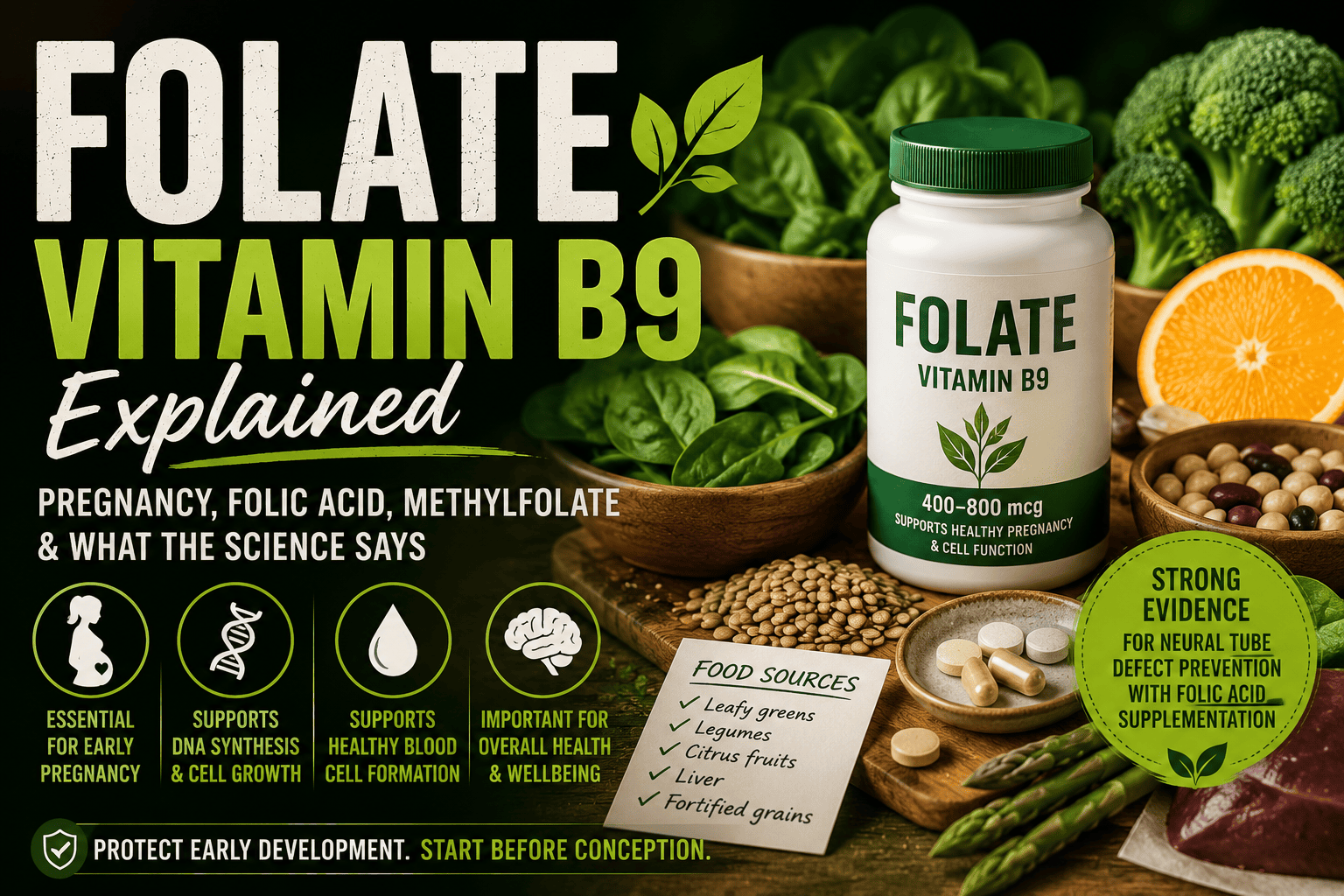
What Foods Naturally Contain Folate?
Fortunately, folate is available naturally in a wide variety of foods.
Good dietary sources include:
- Dark leafy green vegetables
- Broccoli and Brussels sprouts
- Beans
- Lentils
- Peas
- Citrus fruits
- Avocado
- Liver
- Fortified grain and cereal products
The name folate actually comes from the Latin folium, meaning leaf, which is particularly appropriate given how strongly leafy vegetables are associated with dietary folate.
Can You Get Enough Folate From Food During Pregnancy?
A healthy diet containing folate-rich foods is important during pregnancy.
However, dietary folate alone is not considered a substitute for recommended folic acid supplementation around conception and during early pregnancy.
This is partly because the preventive evidence specifically supports supplemental folic acid, and ensuring a consistent protective intake during the critical early developmental window is difficult through diet alone.
Eat the greens.
Still take the recommended folic acid.
Can You Take Too Much Folic Acid?
Yes, which is another reason not to assume that vitamins are automatically harmless at any dose.
Folate naturally present in foods is not generally associated with the same concerns as large supplemental doses of folic acid.
High intakes of folic acid from supplements and fortified foods can conceal the haematological signs of vitamin B12 deficiency, as discussed earlier.
For adults, commonly cited upper intake limits for folic acid from supplements and fortified foods are around 1,000 mcg per day unless a higher amount has been medically recommended.
That upper limit should not be confused with prescribed high-dose folic acid, which is deliberately used in particular clinical situations under appropriate guidance.
What About Folate for Treating Anaemia?
Folic acid is used clinically to treat folate-deficiency megaloblastic anaemia, but treatment doses are different from routine nutritional or pregnancy-prevention doses.
The underlying cause also needs consideration.
Someone with anaemia should not simply take folic acid because their symptoms sound vaguely similar to a list they found online.
Vitamin B12 status, iron status, blood counts and potential underlying causes may all need assessment.
What Forms of Folate Supplements Are Available?
Vitamin B9 appears in several supplement formats.
- Tablets
- Capsules
- Liquid preparations
- Multivitamins
- Pregnancy supplements
- B-complex supplements
The active ingredient will commonly be either folic acid or a form of methylfolate.
Always check the actual amount provided rather than assuming every prenatal or B-complex supplement contains the dose you expect.
Folate vs Folic Acid vs Methylfolate
| Form | What It Is | Common Source | Key Point |
|---|---|---|---|
| Folate | General term commonly used for naturally occurring vitamin B9 compounds | Leafy greens, legumes and other foods | Essential nutrient required from the diet |
| Folic acid | Synthetic form of vitamin B9 | Supplements and fortified foods | Strong evidence for neural tube defect prevention |
| 5-MTHF / methylfolate | Biologically active folate form | Some supplements and clinical products | Legitimate alternative form, but not automatically superior for everyone |
Who Might Particularly Need to Think About Folate?
Folate deserves particular attention in people who:
- Are planning a pregnancy
- Could become pregnant
- Are in early pregnancy
- Have diagnosed folate deficiency
- Have certain malabsorption conditions
- Take medicines that interfere with folate metabolism
- Have medically diagnosed folate-deficiency anaemia
Individual circumstances matter, particularly when medication or an underlying health condition is involved.
Is Folate Worth Supplementing If You’re Healthy?
This is where context becomes everything.
If you are trying to conceive or could become pregnant, recommended folic acid supplementation has an extremely clear rationale.
If you have a diagnosed deficiency, treatment has an equally obvious purpose.
If you eat a varied diet, have adequate folate status, are not in a pregnancy-related risk group and are simply hoping that extra methylfolate will provide superhuman concentration or gym performance, the evidence becomes considerably less exciting.
Essential does not mean more is always better.
The Bottom Line
Folate, or vitamin B9, is genuinely essential.
It plays fundamental roles in DNA synthesis, cell division, red blood cell production and normal development during pregnancy.
Its most important supplementation use is also one of the strongest examples of evidence-based vitamin supplementation: taking folic acid before conception and during early pregnancy significantly reduces the risk of neural tube defects.
In the UK, the standard recommendation is 400 mcg of folic acid daily while trying to conceive and through the first 12 weeks of pregnancy, with higher doses recommended for some people following individual healthcare advice.
Outside pregnancy and genuine deficiency, however, the story becomes less dramatic.
There is no established evidence that routinely taking extra folate turns healthy adults into sharper thinkers, better athletes or human energy machines.
Methylfolate is a legitimate form of vitamin B9, but conventional folic acid has a huge evidence base and should not be dismissed simply because a supplement advert contains the word “methylation” six times.
And high doses deserve respect. Excess supplemental folic acid can obscure the blood abnormalities associated with vitamin B12 deficiency, potentially delaying its recognition while neurological damage progresses.
So folate is not a trendy performance enhancer.
It is something much more useful.
An essential nutrient with a specific, important and genuinely well-supported role when it is actually needed.
Important: This article is for general educational purposes and is not a substitute for individual medical advice. If you are pregnant, trying to conceive, have been diagnosed with anaemia or vitamin B12 deficiency, have a malabsorption disorder, or take medicines that affect folate metabolism, speak to a pharmacist, doctor, midwife or other appropriately qualified healthcare professional about the dose and form appropriate for you.