
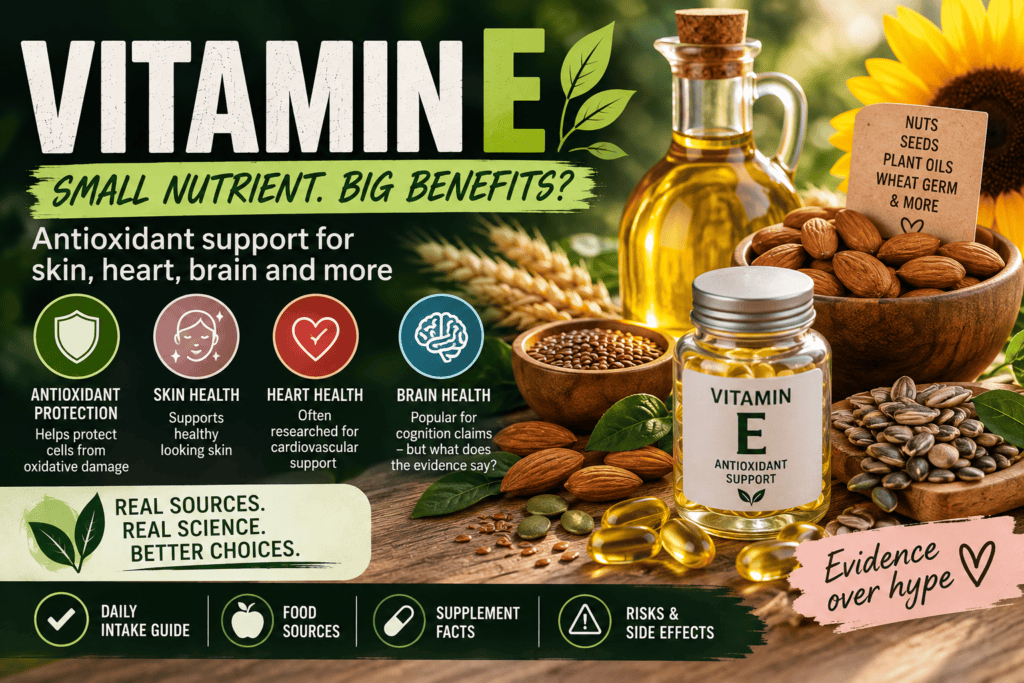
Vitamin E Explained: Antioxidant Benefits, Skin, Heart Health, Brain Claims and What the Science Really Says
Vitamin E has one of those supplement reputations that sounds almost too good to question.
It’s an antioxidant.
Antioxidants are good.
Therefore, taking lots of vitamin E must be even better.
Simple.
Except human biology has an irritating habit of refusing to be that simple.
Vitamin E is genuinely essential. It helps protect cell membranes from oxidative damage and contributes to normal immune and neurological function. Severe deficiency can cause significant health problems, and correcting a genuine deficiency is important.
From there, however, vitamin E’s reputation has expanded considerably.
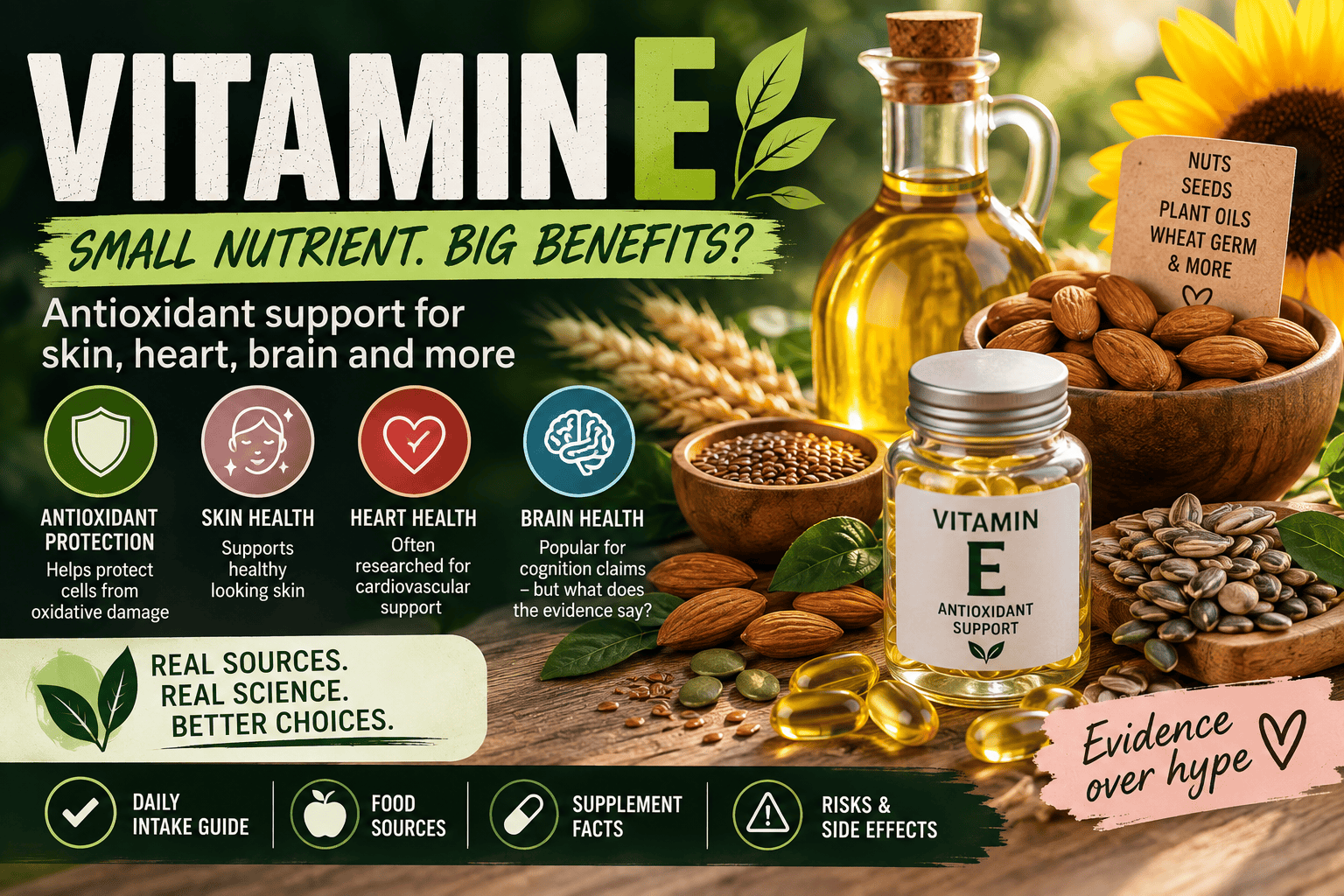
Supplements have been promoted for younger-looking skin, cardiovascular protection, memory, dementia prevention, athletic recovery, immunity, fertility and general anti-ageing.
Some claims are based on genuine biological mechanisms.
Others have struggled when put through good clinical trials.
And perhaps most importantly, taking large doses of vitamin E is not automatically harmless just because vitamin E occurs naturally in almonds and sunflower seeds.
So let’s separate essential nutrition from antioxidant hype.
What Is Vitamin E?
Vitamin E is not actually one single compound.
The term describes a family of eight naturally occurring fat-soluble compounds: four tocopherols and four tocotrienols.
- Alpha-tocopherol
- Beta-tocopherol
- Gamma-tocopherol
- Delta-tocopherol
- Alpha-tocotrienol
- Beta-tocotrienol
- Gamma-tocotrienol
- Delta-tocotrienol
Of these, alpha-tocopherol is the form preferentially maintained by the human body and the form used when nutritional requirements for vitamin E are established.
That’s why supplement labels and nutritional recommendations often focus heavily on alpha-tocopherol.
What Does Vitamin E Actually Do?
Vitamin E’s headline role is as a fat-soluble antioxidant.
To understand why that matters, we need to talk briefly about oxidation.
Normal metabolism continually produces reactive molecules known as free radicals and other reactive oxygen species. Your body also encounters oxidative stress from environmental exposures and biological processes such as inflammation.
This isn’t automatically bad.
Reactive molecules also participate in normal cell signalling and immune responses.
Problems can arise when oxidative activity overwhelms the body’s protective systems and begins damaging important cellular structures.
Vitamin E helps protect polyunsaturated fatty acids within cell membranes from lipid peroxidation, effectively helping interrupt damaging oxidative chain reactions.
That sounds rather more impressive than “antioxidant vitamin”.
And it is important.
If Antioxidants Are Good, Are More Antioxidants Better?
Here we encounter one of the biggest misconceptions in supplement marketing.
Oxidative stress contributes to numerous disease processes.
Vitamin E acts as an antioxidant.
Therefore, it seems perfectly logical that taking enormous amounts of vitamin E should prevent diseases associated with oxidative stress.
Unfortunately, a biologically plausible theory does not automatically produce a clinical benefit.
Large randomised trials of antioxidant supplementation have repeatedly demonstrated why we need clinical outcome data rather than relying solely on biochemical reasoning.
Antioxidants are not a video-game health statistic where adding another 500 points automatically upgrades your character.
Vitamin E and Heart Health
Cardiovascular disease was once one of the most exciting potential applications for vitamin E supplementation.
The theory made sense.
Oxidative modification of LDL particles participates in atherosclerotic processes. Vitamin E is an antioxidant. Therefore, researchers investigated whether supplemental vitamin E could reduce cardiovascular disease.
Observational studies initially produced encouraging associations.
Then better controlled trials arrived.
The overall results have not established routine vitamin E supplementation as an effective strategy for preventing cardiovascular disease in the general population.
That does not mean dietary vitamin E is unimportant.
It means eating foods naturally containing vitamin E and swallowing a high-dose isolated antioxidant supplement are not biologically equivalent interventions.
Does Vitamin E Protect Your Brain?
Another tempting theory.
The brain contains large quantities of lipid-rich tissue and consumes substantial amounts of oxygen, making oxidative processes an obvious area of scientific interest in neurodegenerative disease.
Vitamin E therefore became a candidate for protecting cognition and potentially reducing dementia risk.
But again, the clinical evidence has not lived up to the simplicity of the theory.
Trials in cognitively healthy middle-aged and older adults have not established vitamin E supplementation as a reliable way to preserve cognition or prevent dementia.
So vitamin E is important for normal neurological physiology.
It is not an established nootropic.
What About Alzheimer’s Disease?
This requires a little more nuance.
Research has investigated high-dose vitamin E in people with mild cognitive impairment and Alzheimer’s disease.
Available evidence has not shown that vitamin E prevents people with mild cognitive impairment from progressing to Alzheimer’s dementia, nor has it demonstrated a convincing improvement in cognition.
One trial in people with Alzheimer’s disease suggested vitamin E may have slowed decline in the ability to perform some daily activities, but that is a very different claim from saying vitamin E prevents dementia or improves memory.
Context matters enormously here.
Using a particular high-dose treatment under medical supervision in a specific disease population is not evidence that healthy adults should buy high-dose vitamin E supplements “for brain health”.
Vitamin E and Skin Health
Now we arrive at probably vitamin E’s most photogenic claim.
Skin.
Vitamin E is naturally present within the skin and contributes to its antioxidant defence system.
That makes it a popular ingredient in moisturisers, oils, serums, supplements and products promising everything from glowing skin to disappearing scars.
The reality is more restrained.
Adequate vitamin E nutrition supports normal physiology, including skin health. However, evidence does not support the idea that routinely taking high-dose oral vitamin E will transform the appearance of healthy skin.
And topical vitamin E deserves its own caution.
Despite its popularity for scars, evidence that topical vitamin E reliably improves scar appearance is weak, and some people develop skin irritation or contact dermatitis.
A vitamin being good for skin biology doesn’t mean rubbing concentrated versions of it onto every scar guarantees a better result.
Does Vitamin E Improve Exercise Performance?
Exercise produces reactive oxygen species.
Vitamin E is an antioxidant.
You can probably predict where the supplement theory goes next.
Antioxidant supplements have been investigated as a way to reduce exercise-induced oxidative stress, muscle damage and fatigue.
However, routine vitamin E supplementation has not been established as a reliable method for improving strength, endurance, muscle growth or general athletic performance in healthy, adequately nourished adults.
There is also a broader complication with very high antioxidant supplementation around exercise.
Some reactive oxygen species produced during exercise act as signalling molecules involved in adaptation. Completely suppressing every oxidative signal would not necessarily be desirable, even if it were possible.
The goal of human physiology isn’t “zero oxidation”.
It’s balance.
What Does Vitamin E Deficiency Look Like?
True vitamin E deficiency is uncommon in otherwise healthy people.
Because vitamin E is fat soluble, deficiency is more commonly associated with conditions that severely impair fat absorption or with certain rare inherited disorders.
Significant deficiency can affect the nervous system and muscles.
Possible manifestations include:
- Peripheral neuropathy
- Muscle weakness
- Problems with coordination or movement
- Retinal problems
- Impaired immune function
These are not symptoms that should be self-diagnosed as “probably low vitamin E”.
Neurological symptoms have many possible causes and deserve proper medical assessment.
Who Is at Greater Risk of Vitamin E Deficiency?
People with disorders that substantially impair the digestion or absorption of dietary fat are at greater risk because vitamin E depends on normal fat absorption.
This can include certain people with:
- Cystic fibrosis
- Crohn’s disease or other significant malabsorptive disorders
- Some pancreatic or biliary disorders
- Rare inherited conditions affecting vitamin E metabolism
In these circumstances supplementation may be clinically important, but the appropriate dose can be very different from ordinary over-the-counter nutritional supplementation.
How Much Vitamin E Do You Need?
This is another nutrient where recommendations vary between countries.
In the United States, the Recommended Dietary Allowance for adults is:
15 mg per day of alpha-tocopherol.
UK recommendations are considerably lower.
The NHS states that adults need approximately:
- 4 mg per day for men
- 3 mg per day for women
This difference does not mean one country believes vitamin E suddenly becomes more powerful when it crosses the Atlantic.
Different authorities use different methods and definitions when establishing nutritional reference values, so recommendations are not always directly interchangeable.
For most healthy adults in the UK, a varied and balanced diet should provide sufficient vitamin E.
Where Can You Get Vitamin E Naturally?
Fortunately, vitamin E lives in some very ordinary foods.
Useful dietary sources include:
- Sunflower seeds
- Almonds and other nuts
- Hazelnuts
- Wheatgerm
- Sunflower oil
- Rapeseed oil
- Soya oil
- Corn oil
- Olive oil
- Some fortified cereals and foods
Nuts and seeds are particularly useful because they provide vitamin E alongside unsaturated fats, fibre, minerals and other nutrients.
Which is considerably more nutritional baggage than you’ll find inside an isolated softgel.
Vitamin E Is Fat Soluble. What Does That Mean?
Vitamin E is one of the four major fat-soluble vitamins, alongside vitamins A, D and K.
Its absorption therefore depends on the processes used to digest and absorb dietary fat.
Unlike water-soluble vitamins that are more readily excreted in urine, fat-soluble vitamins can be stored within the body.
This is one reason the casual idea that “you’ll just pee out whatever you don’t need” does not apply to every vitamin supplement.
Your kidneys are not an unlimited supplement refund department.
What Forms of Vitamin E Are Available?
Vitamin E supplements come in several forms, including:
- Softgels
- Capsules
- Tablets
- Liquids
- Multivitamin products
- Topical oils and creams
You may also see labels distinguishing between natural and synthetic alpha-tocopherol.
Historically, natural alpha-tocopherol may appear as d-alpha-tocopherol, while synthetic mixtures may be labelled dl-alpha-tocopherol.
The forms differ in biological activity, so comparing products purely by the number printed on the front of the bottle can be misleading.
Milligrams vs IU: Why Vitamin E Labels Can Be Confusing
Vitamin E has historically been labelled in International Units, or IU.
Modern nutritional recommendations increasingly use milligrams of alpha-tocopherol, which makes sense but has left consumers staring at older and newer labels wondering whether 400 IU and 400 mg are the same thing.
They aren’t.
The conversion depends on whether the vitamin E is natural or synthetic.
This is another reason to read the complete supplement label rather than assuming the biggest-looking number represents the best product.
Can You Take Too Much Vitamin E?
Yes.
This is where vitamin E’s wholesome antioxidant image becomes considerably more complicated.
Vitamin E obtained naturally from foods is not generally a toxicity concern.
High-dose supplements are different.
Large supplemental doses can interfere with normal blood coagulation and may increase bleeding risk.
At sufficiently high intakes this includes concern about serious bleeding, including haemorrhagic stroke.
So “it’s just a vitamin” is not a particularly useful safety assessment.
Vitamin E and Bleeding Risk
Vitamin E can influence platelet aggregation and vitamin K-dependent coagulation processes, particularly at high supplemental doses.
This becomes especially relevant when someone is already taking medication designed to reduce blood clotting.
Combining a high-dose vitamin E supplement with anticoagulant or antiplatelet therapy can potentially increase bleeding risk.
That brings us to an important practical rule.
If you take medication affecting blood clotting, do not assume high-dose vitamin E is harmless because you can buy it without a prescription.
Vitamin E and Warfarin
People taking warfarin should be particularly careful about starting vitamin E supplements.
High supplemental vitamin E intake may increase bleeding risk when combined with warfarin and other anticoagulant medicines.
This does not mean someone taking warfarin needs to panic about the vitamin E naturally present in a handful of almonds.
Normal dietary intake and concentrated high-dose supplementation are very different exposures.
If you’re taking warfarin, another anticoagulant or antiplatelet medication, speak to a pharmacist or prescriber before starting a significant vitamin E supplement.
Can Vitamin E Supplements Actually Increase Health Risks?
This is the part that demonstrates why supplements need proper trials.
The SELECT trial investigated vitamin E and selenium for prostate cancer prevention in tens of thousands of men.
Vitamin E did not prevent prostate cancer.
More concerningly, men assigned to 400 IU per day of synthetic vitamin E had a statistically significant increase in prostate cancer risk during extended follow-up.
That doesn’t mean ordinary dietary vitamin E causes prostate cancer.
It doesn’t mean everyone who has ever taken a vitamin E capsule should panic either.
It means high-dose isolated supplementation can have biological consequences that aren’t predicted simply by knowing that the nutrient is essential.
More is not always better.
Sometimes more is just more.
Does Vitamin E Boost Immunity?
Vitamin E contributes to normal immune function, and deficiency can impair aspects of immunity.
That statement is well established.
The leap from that statement to “high-dose vitamin E boosts your immune system” is much less secure.
Correcting inadequate nutritional status and pharmacologically loading a healthy person with large amounts of an antioxidant are not the same intervention.
If you already obtain adequate vitamin E, more supplementation does not reliably turn your immune system into an upgraded version of itself.
Does Vitamin E Improve Fertility?
Oxidative stress is involved in reproductive biology, so antioxidant supplements including vitamin E have been investigated in both male and female fertility.
Some individual studies and combinations of antioxidants have produced interesting results, but evidence is not strong enough to recommend routine high-dose vitamin E as a universal fertility treatment.
Fertility is complex.
A single antioxidant is unlikely to provide a simple answer to a problem with dozens of potential causes.
Food Vitamin E vs Supplement Vitamin E
This distinction deserves far more attention.
Eating nuts, seeds and plant oils means consuming vitamin E within a complex food matrix alongside unsaturated fats, minerals, fibre and numerous other compounds.
Taking a high-dose alpha-tocopherol capsule creates a very different nutritional exposure.
That’s why research associating vitamin E-rich diets with good health cannot automatically be used as evidence that high-dose vitamin E supplements provide the same benefits.
The food is not merely a vitamin delivery vehicle.
It’s food.
Do Most People Need a Vitamin E Supplement?
Probably not.
Most healthy adults eating a varied diet should be able to obtain sufficient vitamin E from food.
Supplementation has a much clearer role when someone has a diagnosed deficiency, significant malabsorption or another medical indication where vitamin E status requires specific management.
Taking large doses “just in case” is harder to justify.
Vitamin E Claims: Evidence Check
| Claim | What the Evidence Suggests |
|---|---|
| Vitamin E is essential | Yes. It is an essential fat-soluble nutrient with important antioxidant and physiological functions. |
| Correcting deficiency is beneficial | Yes. Genuine deficiency requires appropriate treatment. |
| Vitamin E prevents heart disease | Routine supplementation has not been established as an effective cardiovascular prevention strategy. |
| Vitamin E prevents dementia | Not established. Trials do not support routine supplementation for cognitive protection in healthy adults. |
| Vitamin E is a nootropic | No reliable cognitive enhancement has been established in vitamin E-replete adults. |
| Vitamin E improves athletic performance | Not reliably established. |
| Vitamin E improves healthy skin | Adequate vitamin E supports normal skin physiology, but high-dose oral supplementation is not a proven skin transformation treatment. |
| High-dose vitamin E is harmless | No. High supplemental doses can increase bleeding risk and have produced other safety concerns in clinical trials. |
So, Is Vitamin E Good or Bad?
Neither question is particularly helpful.
Vitamin E is essential.
Deficiency is bad.
Adequate intake is good.
High-dose supplementation without a clear reason may be unnecessary and can sometimes be harmful.
Those statements can all be true at exactly the same time.
Nutrition becomes confusing when we try to divide nutrients into heroes and villains.
Vitamin E doesn’t need to be either.
The Bottom Line
Vitamin E deserves more respect than hype.
It is an essential fat-soluble vitamin and antioxidant that helps protect cell membranes against oxidative damage and contributes to normal neurological and immune function.
Getting enough matters.
Taking huge amounts does not automatically matter more.
For healthy adults, evidence does not establish routine vitamin E supplementation as a reliable way to prevent cardiovascular disease, improve cognition, prevent dementia or enhance exercise performance.
Vitamin E’s reputation for skin health also deserves perspective. Adequate nutrition supports normal skin physiology, but swallowing high-dose vitamin E is not a proven shortcut to younger or dramatically healthier-looking skin.
Meanwhile, high supplemental doses can increase bleeding risk and may interact with anticoagulant and antiplatelet medicines.
And large clinical trials have given us an important reminder that antioxidant supplements can sometimes produce unexpected harm rather than additional protection.
For most people, the sensible strategy is considerably less exciting than the supplement advertising.
Eat the nuts.
Eat the seeds.
Use appropriate plant oils as part of a balanced diet.
And don’t assume that putting 400 IU into a shiny softgel turns an essential nutrient into an anti-ageing superpower.
Vitamin E is important. More vitamin E is not automatically more health.
Important: This article is for general educational purposes and is not a substitute for individual medical advice. Speak to a pharmacist, doctor, dietitian or other appropriately qualified healthcare professional before using high-dose vitamin E supplements, particularly if you take warfarin, another anticoagulant or antiplatelet medicine, have a bleeding disorder, are undergoing cancer treatment, have a condition affecting fat absorption, are pregnant or breastfeeding, or believe you may have a nutritional deficiency.