
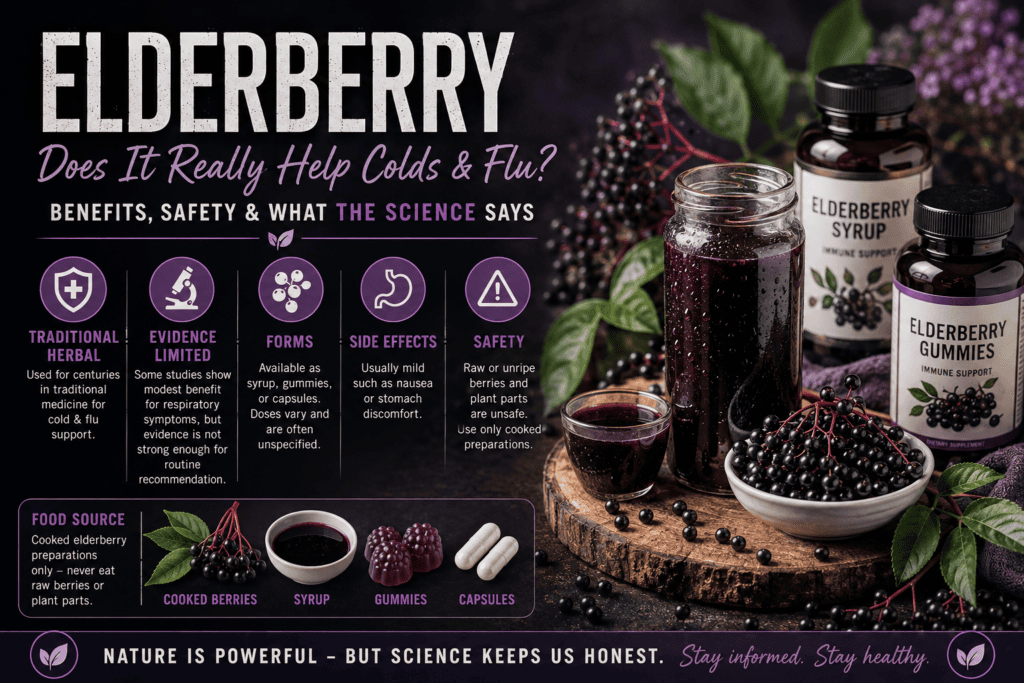
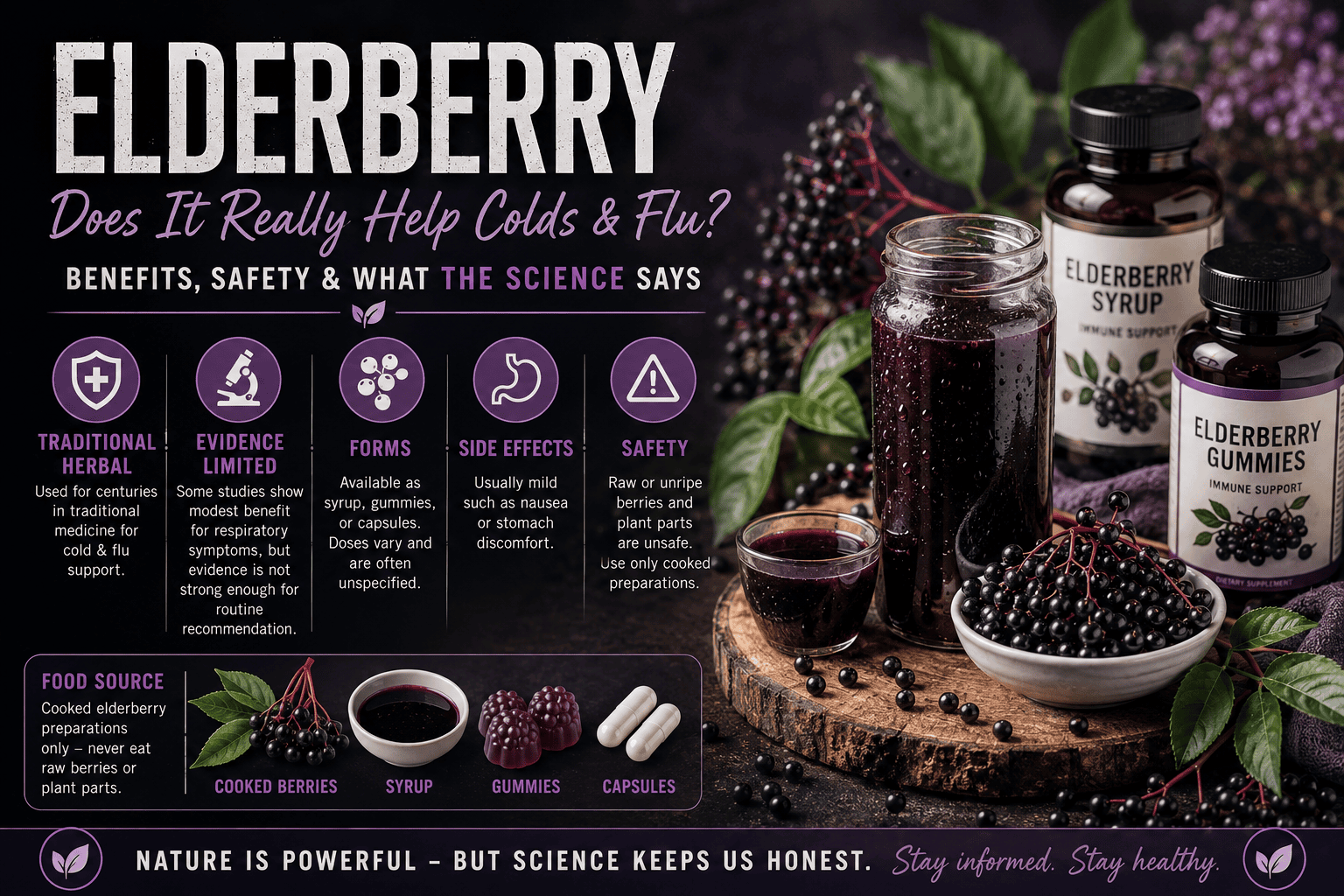
Elderberry Explained: Does It Really Help Colds and Flu? Benefits, Safety, and What the Science Says
Every cold and flu season, elderberry seems to make the same dramatic comeback.
Syrups appear in kitchen cupboards. Gummies start appearing in supplement routines. Social media fills with claims about “natural immune support”, and suddenly this tiny dark-purple berry is expected to go head-to-head with an entire collection of respiratory viruses.
It sounds impressive.
But does elderberry actually work?
The answer is considerably less exciting than much of the marketing surrounding it. Elderberry contains biologically interesting compounds and has been investigated for respiratory infections, including the common cold and influenza. However, the available clinical evidence remains limited, inconsistent, and heavily dependent on the particular elderberry preparation being studied.
In other words, elderberry is interesting. It just hasn’t earned miracle status.
What Is Elderberry?
Elderberries are the dark berries produced by elder plants. European black elder, Sambucus nigra, is commonly used in commercial elderberry supplements and food preparations.
The berries contain various plant compounds, including anthocyanins and other polyphenols. Anthocyanins are pigments responsible for many of the deep red, blue, and purple colours found throughout the plant world.
Elderberry has a long history of traditional use, but modern supplements have taken that history considerably further. Products are now frequently marketed for immune health, cold relief and seasonal respiratory support.
That is where we need to separate tradition from clinical evidence.
Why Has Elderberry Become So Popular?
The appeal is fairly obvious.
Colds are annoying. Flu can make you feel absolutely dreadful. If a spoonful of berry syrup could significantly shorten either illness, most of us would happily keep a bottle permanently stationed beside the kettle.
Elderberry also fits perfectly into modern wellness marketing. It is plant-derived, colourful, traditional, available as a pleasant-tasting syrup or gummy, and associated with immune health.
Unfortunately, none of those things automatically tell us whether it works clinically.
Does Elderberry Actually Help the Common Cold?
There have been clinical studies investigating elderberry preparations for respiratory symptoms, and some have reported reductions in symptom severity or duration.
That sounds encouraging.
The problem is that the overall evidence base is relatively small. Studies have used different products, preparations, doses, populations and outcomes, making it difficult to draw firm conclusions.
Systematic reviews have generally concluded that elderberry might reduce some upper respiratory symptoms, but the certainty of the evidence is low. Larger, well-designed independent trials are still needed before we can confidently recommend elderberry as an effective cold treatment.
So, could it help a little?
Possibly.
Can we confidently say it will stop your cold?
No.
What About Flu?
Elderberry is perhaps even more famous for influenza claims.
Some small clinical trials have suggested that particular elderberry products might reduce the duration or severity of influenza-like symptoms. However, these studies are not strong enough to establish elderberry as a reliable treatment for influenza.
More recent research has also failed to consistently reproduce dramatic benefits.
That matters because early positive research can generate enormous enthusiasm around a supplement long before the scientific picture becomes clear.
Elderberry should therefore not be considered a replacement for influenza vaccination, appropriate medical assessment, or antiviral medication when clinically indicated.
Does Elderberry Boost Your Immune System?
“Boosts immunity” is one of those phrases that appears everywhere in supplement marketing while explaining remarkably little.
The immune system is an extraordinarily complicated network of cells, tissues, signalling molecules and organs. You do not simply turn it up like the volume on a television.
Laboratory research suggests compounds within elderberry can interact with biological pathways relevant to immune responses. That makes elderberry scientifically interesting, but laboratory activity does not automatically translate into meaningful protection against illness in humans.
The clinically relevant question is not whether elderberry does something in a laboratory.
It is whether taking it produces a worthwhile health outcome.
At present, that remains uncertain.
Can Elderberry Prevent You From Getting Sick?
There is currently insufficient high-quality evidence to recommend elderberry routinely for preventing viral respiratory infections.
This distinction is important.
A supplement potentially reducing symptoms after an infection has developed is not the same thing as preventing that infection in the first place.
Marketing occasionally allows those two ideas to become suspiciously close neighbours.
Why Elderberry Research Is Difficult to Interpret
One of the recurring problems with herbal supplement research is standardisation.
An elderberry supplement is not necessarily equivalent to another elderberry supplement.
Products can vary according to:
- Elder species
- Which parts of the plant are used
- Extraction and processing methods
- Concentration
- Additional ingredients
- Final formulation
A study showing a potential benefit from one standardised extract therefore does not prove that every elderberry gummy, syrup or capsule on a supermarket shelf will produce the same effect.
This is an important principle across herbal medicine generally.
How Much Elderberry Should You Take?
This is where giving a universal number becomes problematic.
There is no single established evidence-based elderberry dose that applies to every product.
Commercial formulations vary considerably. A syrup, concentrated liquid extract, capsule and gummy may contain completely different preparations, making simple milligram comparisons potentially misleading.
If using a commercial product, follow the manufacturer’s directions rather than assuming that the dose used for another elderberry preparation applies to yours.
What Forms Does Elderberry Come In?
Elderberry has become particularly versatile in the supplement aisle.
Common forms include:
- Syrups
- Liquid extracts
- Gummies
- Capsules
- Tablets
- Cooked elderberry food preparations
Syrups and gummies are particularly popular during winter, partly because they are considerably easier to persuade someone to take than another enormous beige supplement tablet.
Is Elderberry Safe?
Properly prepared commercial elderberry products are generally well tolerated when used according to their instructions.
Reported side effects are usually mild and primarily gastrointestinal, including:
- Nausea
- Stomach discomfort
- Diarrhoea
However, there is a very important distinction between properly processed elderberry products and eating parts of the plant raw.
Why Raw Elderberries Can Be Unsafe
Raw or unripe elderberries, as well as other parts of the elder plant such as leaves and stems, can contain cyanogenic glycosides. These compounds can release cyanide when metabolised.
That sounds alarming because, frankly, it should.
Eating inadequately prepared elder plant material can cause nausea, vomiting, abdominal cramps and diarrhoea. Proper cooking and commercial processing greatly reduces this risk.
The practical rule is simple: do not treat raw elderberries or random parts of an elder plant as though they were ordinary snack berries.
What About Homemade Elderberry Syrup?
Homemade elderberry preparations have become popular, particularly through social media and traditional wellness communities.
The safety issue is preparation.
Correct identification of the plant, removal of inappropriate plant material and adequate cooking are essential. Improvised recipes using raw or insufficiently processed berries may carry unnecessary risk.
Natural ingredients still contain chemistry. Nature did not sign a contract promising everything growing on a bush would be safe to eat.
Elderberry Gummies: Helpful or Just Expensive Sweets?
Possibly somewhere in between.
Gummies can provide elderberry extracts in a convenient form, but consumers should check exactly what the product contains.
Look at the specific elderberry preparation, recommended serving, additional vitamins or minerals, and sugar content rather than judging the product entirely by the enormous purple berry pictured on the front.
Remember that evidence from a clinical trial using one standardised elderberry preparation cannot automatically be transferred to a completely different gummy formulation.
Does Elderberry Improve Energy, Exercise Performance or Brain Function?
There is no established evidence that elderberry acts as a nootropic, improves athletic performance, increases strength, or provides a meaningful energy boost in healthy adults.
Its scientific interest is overwhelmingly centred around respiratory illness and immune-related effects.
If a product promises better memory, enormous energy improvements and superhuman gym performance alongside its elderberry content, it may be worth examining what else is actually inside the bottle.
What Actually Helps During Cold and Flu Season?
This is perhaps the less glamorous part of the conversation.
No herbal syrup compensates for consistently poor sleep, inadequate nutrition or ignoring basic infection-control measures.
A sensible approach includes:
- Getting adequate sleep
- Eating a varied, nutritionally adequate diet
- Correcting genuine nutrient deficiencies where appropriate
- Regular handwashing and sensible hygiene
- Keeping recommended vaccinations up to date
- Staying physically active
- Seeking medical advice when symptoms are severe or concerning
Not particularly glamorous.
Still important.
So, Is Elderberry Worth Taking?
For most healthy adults, a properly prepared elderberry product is unlikely to be particularly dramatic in either direction.
There is some preliminary evidence suggesting certain preparations could modestly improve respiratory symptoms, but the overall evidence remains too limited and inconsistent to recommend elderberry routinely for preventing or treating colds and influenza.
If you enjoy an elderberry product, tolerate it well, understand its limitations and use a properly manufactured preparation, that is very different from relying on it as a proven antiviral treatment.
Expectations matter.
The Bottom Line
Elderberry is a traditional herbal remedy that has attracted considerable attention for common cold, influenza and immune-support claims.
Some small studies have produced encouraging findings, but current evidence remains limited and product-specific. Any benefit appears likely to be modest, and we do not currently have strong enough evidence to recommend elderberry routinely for preventing or treating viral respiratory infections.
Commercially prepared syrups, gummies, capsules and extracts are generally well tolerated, although mild gastrointestinal side effects can occur. Raw or unripe berries and other inappropriate parts of the elder plant should not be consumed because of potentially toxic cyanogenic compounds.
Elderberry therefore sits in a familiar position within supplement science.
Interesting? Yes.
Potentially useful? Maybe.
A proven cure for your winter cold? Unfortunately not.
(Small note: if purple berry syrup genuinely made us invincible against every winter virus, pharmacies would probably have considerably quieter Januarys.)
Important: This article is for general educational purposes and is not a substitute for individual medical advice. Seek advice from a qualified healthcare professional if you are pregnant, breastfeeding, giving supplements to children, taking medication, have an existing medical condition, or are concerned about respiratory symptoms.